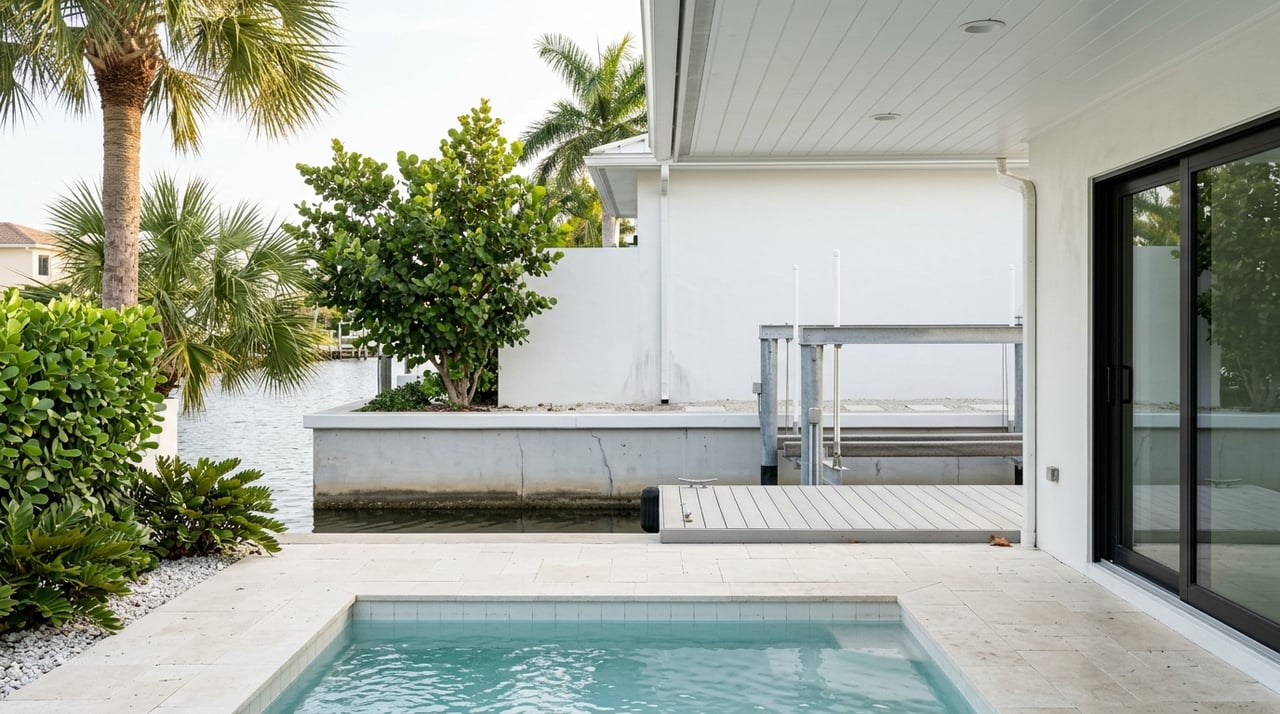
Buying A Waterfront Home In Lighthouse Point FL
June 4, 2026
June 4, 2026
If you are buying a waterfront home in Lighthouse Point, the view is only part of the story. What really shapes value, day-to-day use, and long-term cost is what sits behind the listing photos: boat access, bridge clearance, seawall condition, permit history, and insurance. If you want a home that fits your lifestyle and protects your investment, it helps to know what to check before you fall in love with the dock. Let’s dive in.
Lighthouse Point has a strong waterfront identity. According to the city, about 80% of residences are single-family homes, and many sit along its 18 miles of waterways. The east side opens toward the Intracoastal Waterway near the Hillsboro Lighthouse, which helps explain why the city is such a draw for buyers who want a true boating-centered lifestyle.
This is also a built-out coastal city, which matters when you shop here. In a built-out market, location details and property features tend to carry even more weight because there is limited room for new supply. That makes careful comparison especially important when two homes look similar online but offer very different real-world utility.
Current listing data shows that waterfront options exist, but they come at a premium. Redfin shows 79 waterfront homes in Lighthouse Point with a median listing price of about $995,000, while Realtor.com reports 240 homes citywide with a median listing price of $1.0935 million and median days on market of 76 as of March 2026. Realtor.com also describes the city as a buyer’s market, which may create room for more thoughtful negotiation.
In Lighthouse Point, “waterfront” is a broad label. Two homes can both sit on the water and still have very different value based on frontage, water depth, boat lift capacity, and route to the inlet. That is why buyers should look beyond the word waterfront and dig into the boating package attached to the property.
Recent active listings help show how much these details matter. One property is marketed with 100 feet of frontage and quick inlet access, another with 116 feet of deep-water frontage and a 25,000-pound boat lift, and another with 80 feet of deep water and no fixed bridges. Those differences can drive major pricing gaps, even within the same city.
Neighborhood-level pricing also varies sharply. Realtor.com reports median listing prices around $2.15 million in Venetian Isles and about $3.245 million in Coral Key Villas. That does not mean one area is automatically better for every buyer, but it does show how strongly location and waterfront utility affect pricing inside Lighthouse Point.
If you own a boat, or plan to, the most important question is simple: how well does the property work for your actual vessel? A waterfront home can look perfect on paper and still create headaches if the route to open water is tight, shallow, or affected by bridge clearance.
NOAA’s Coast Pilot notes that Hillsboro Inlet connects with the Hillsboro River and the Intracoastal Waterway and serves as an important base for fishermen running to the Gulf Stream. It also notes that the inlet entrance channel is marked by lights, daybeacons, and a lighted buoy. Just as important, NOAA states that the Route A1A bridge has a 13-foot clearance and that current past the bridge can reach 5 to 6 knots on a flood tide.
Those details matter in real life. A boat that fits at the dock still has to make the trip safely from canal to Intracoastal to inlet. That is why you want to verify the full route, not just the dock specs.
When you are comparing waterfront homes in Lighthouse Point, make sure you confirm:
This is where practical due diligence protects you. The boating setup is not just an extra amenity. In many cases, it is a major part of the property’s value.
A waterfront home comes with more infrastructure than an inland property. In Lighthouse Point, that means the dock and seawall deserve serious attention before you move forward. These items can affect safety, future renovation plans, and your total cost of ownership.
The city requires permits for docks, seawalls, patios, generators, and many other exterior projects. Its dock and seawall checklist requires outside approvals from Broward County, the Florida Department of Environmental Protection, or the Army Corps of Engineers, plus an updated dock and seawall survey before final inspection. For re-deck or dock work, the city also requires DEP approval and may require a survey that is less than 12 months old if the survey has changed.
If you are planning a major renovation or a new home build, the review can go further. Lighthouse Point requires two signed and sealed engineer letters stating that the seawall is in condition to support the upland improvements for substantial additions or new residences. In plain English, if you want to build bigger later, the seawall may become a critical part of that conversation.
Before you buy, ask for clear documentation on:
This is especially important if you are buying an older home with plans to update it after closing. A nice lot and wide canal do not remove the need for city approvals and solid paperwork.
Many waterfront buyers in Lighthouse Point are drawn to older homes with good bones, larger lots, or renovation potential. That can be a smart path, but it calls for a little more homework.
Broward County requires building safety inspections on buildings over 25 years old and over 3,500 square feet. Single-family homes, duplexes, and buildings under 3,500 square feet are exempt. If you are looking at a larger older property, age, square footage, and renovation history should be part of your review early in the process.
Even when a formal county rule does not apply, older waterfront homes can still carry more unknowns. Prior updates, permit records, and the condition of exterior systems often matter as much as the cosmetic finish level. This is one area where a calm, document-first approach can save you money and stress later.
One of the biggest mistakes out-of-state buyers make is focusing on price alone. In South Florida, the better way to evaluate a waterfront home is through total monthly carrying cost, not just the purchase price.
Lighthouse Point says the city is in a flood-prone area, encourages adequate flood insurance, and keeps elevation certificates on file for some properties. FEMA states that Special Flood Hazard Areas shown on Flood Insurance Rate Maps are the areas where mandatory flood insurance purchase applies. FEMA also notes that flood insurance is separate because most homeowners insurance does not cover flood damage.
Florida insurance rules add another layer. The Florida Department of Financial Services says homeowners insurance is not required by state law, though a lender may require it. The state also says insurers must offer hurricane-loss mitigation discounts and use the uniform wind-mitigation verification form, which can remain valid for up to five years if the structure has not materially changed.
The Florida Office of Insurance Regulation also says insurers must offer hurricane deductible options of $500, 2%, 5%, or 10% of dwelling or structure limits. That means two buyers looking at the same home may be comfortable with very different risk and monthly cost profiles depending on the deductible structure they choose.
If you are serious about a waterfront purchase, get insurance pricing early. That should include:
This is especially important for relocations from the Midwest or other inland markets, where insurance expectations can be very different. The monthly number that matters is not just mortgage, taxes, and utilities. On a South Florida waterfront home, insurance can be a major budget line item.
If you want to buy with fewer surprises, keep your due diligence simple and practical. Here is a strong starting framework for Lighthouse Point waterfront homes:
This process may sound detailed, but that is the point. Waterfront homes are different, and good preparation helps you avoid expensive assumptions.
The right waterfront home in Lighthouse Point is not always the one with the flashiest photos. Often, it is the property where the boating access matches your vessel, the seawall and dock are well documented, and the insurance picture makes sense for your budget.
That kind of purchase takes a little more digging, but it usually leads to better outcomes. If you stay focused on usability, documentation, and long-term cost, you give yourself a better chance of buying a home you can enjoy with confidence.
If you are weighing waterfront options in Broward County and want a straightforward second set of eyes on the numbers, access, and tradeoffs, Ryan Gritters can help you buy with less guesswork and better preparation.
From pricing and marketing to negotiation and closing coordination, every detail is handled with precision. The goal is simple: deliver a seamless experience tailored to individual goals and timelines.
Ryan Gritters
2424 N Federal Hwy, Ste 150 Boca Raton, FL 33431